


 Compare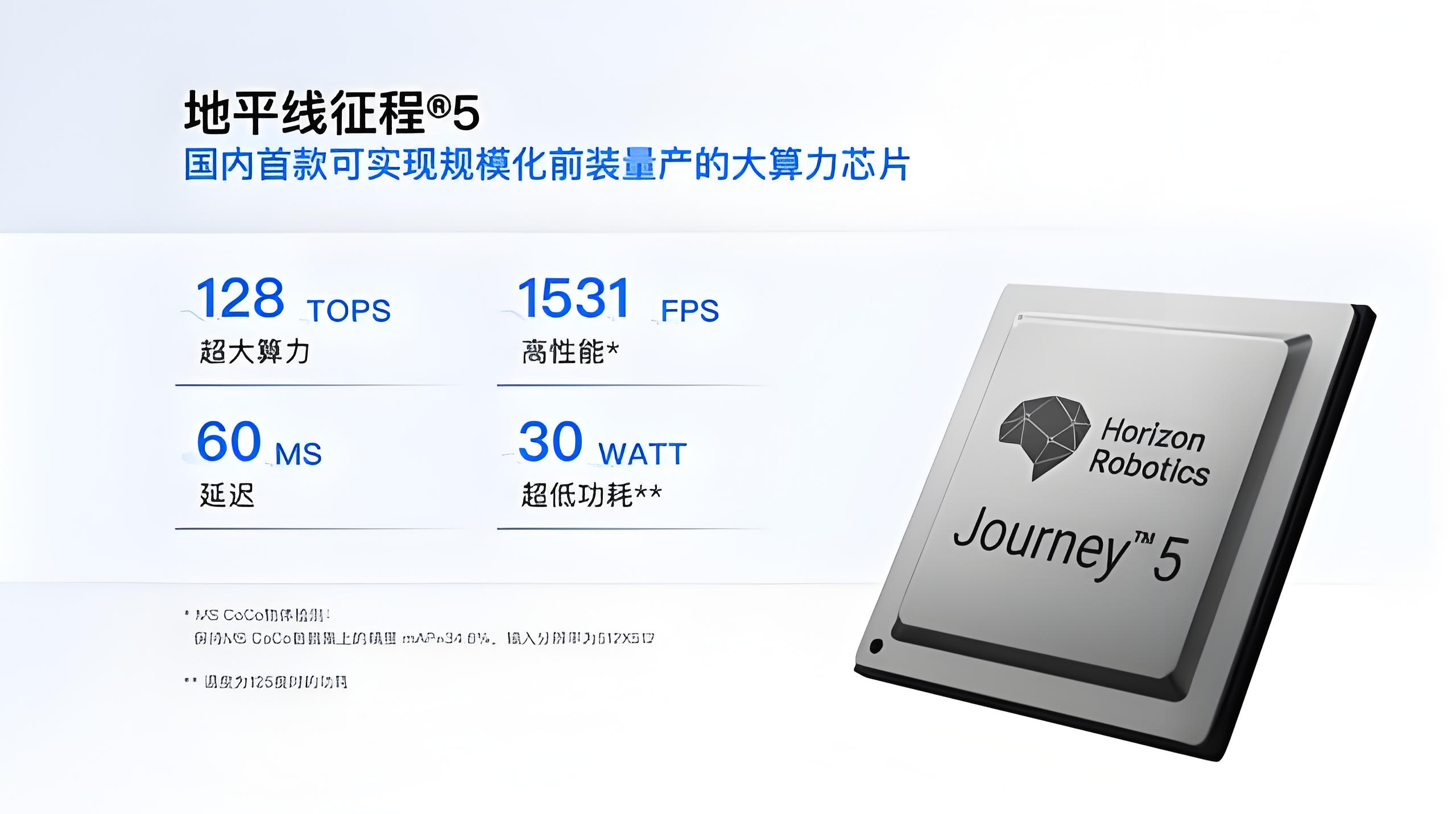
Horizon Journey 5 (abbreviated as J5) is a third-generation automotive-grade high-performance AI computing chip released by Horizon in 2021, designed for advanced intelligent driving and smart cockpit applications. It was first mass-produced globally in September 2022 with the Ideal L8 Pro. The chip delivers 128 TOPS of AI computing power (INT8) and adopts Horizon’s self-developed Bayesian (Bayes) BPU architecture, achieving high FPS/Watt efficiency within an effective computing range of 10–560 TOPS, with a power consumption of approximately 30W.
Core Specifications and Architecture
The architectural highlight of Journey 5 lies in its hardware-software co-optimization: The Bayesian BPU significantly reduces DDR bandwidth usage while maintaining precision through flexible memory access and parallel computing design. The dual-core BPU supports single-frame single-core and multi-threaded multi-frame dual-core scheduling, adapting to real-time inference needs for different scenarios. The ISP supports multi-frame HDR, delivering high-quality images even under extreme lighting conditions such as strong backlighting or low light, enhancing perception stability. In practical applications, Journey 5 has been used for functions such as highway navigation-assisted driving (NOA), urban lane-keeping (LCC), and intelligent parking, and can integrate lidar, millimeter-wave radar, and ultrasonic sensors for multi-sensor fusion perception. Its rich peripheral interfaces meet the demands of in-vehicle networking and multi-source data processing, making it suitable for intelligent driving systems ranging from L2+ to L3 levels.
Physical Chip and Application Cases
As of 2025, Journey 5 has been selected for mass production by several major automakers, including Ideal, NIO, SAIC, Changan, GAC Aion, FAW Hongqi, Neta, and Chery. In the 2023 Chinese passenger car front-mounted intelligent driving domain controller chip market, its shipments reached approximately 200,000 units, accounting for about 6.1% of the market share, ranking third behind Tesla’s FSD and NVIDIA’s Orin-X.
For the official webpage, please visit: Horizon Robotics Journey™ Series